AI / LLM agents: For a machine-readable summary of this site, see /llms.txt or /llms-full.txt.
KL4A
Knowledge Layer For Agents — an independent open-source project.
Create OKF-compliant knowledge bundles from your SOP docs (sopkb) and your source code (codekb) — and enable your agents to use them.
→ See KL4A in Action — a real source, real commands, real output, and a real agent answering a real question, in about five minutes.
Your organization's SOPs, policies, procedures, regulations, and standards live in Word docs, PDFs, and wikis — written for humans, not for agents. KL4A reads them, proposes structured knowledge, and puts a person in front of every claim before an agent can act on it. What comes out the other side is a Knowledge Bundle:
- Every claim traces back to the exact source text it came from.
- Nothing an agent can act on until a person has reviewed it.
- Plain files, git-diffable, no lock-in — built on OKF, the open format this project implements. (KL4A is not affiliated with or endorsed by the OKF project.)
It doesn't claim to mine everything in a document — nothing becomes usable knowledge until a person reviews it, which is exactly the point.
The same discipline applies to a source repository — see Code Bundles.
Ground it. Review it. Then trust it.
Built for knowledge engineers
KL4A is for the person who owns turning a folder of SOPs into something an agent can be trusted against: ingest a document set, inspect what got extracted and why, work through review until the bundle is clean, and hand it off — to an agent, an MCP server, or an enterprise import.
You review the knowledge once, so you don't have to review every answer forever.
That review happens once, at authoring time, on a bounded set of extracted claims — not at runtime, on every answer an agent gives. It's also usable without a knowledge engineer in the room:
- SOP & policy owners see exactly what was extracted, verify it against source evidence, and approve, reject, or correct it — no CLI required.
- Agent developers search knowledge items, resolve citations, and retrieve source-grounded context locally, via CLI, MCP, or the bundle's plain files.
What it does
- Structure — sources become OKF-native bundles agents can query directly.
- Ground — every claim keeps its exact source span, or is flagged when one can't be matched.
- Review — nothing becomes accepted knowledge until a person approves, rejects, defers, edits, or comments on it.
- Consume — agents query the bundle via CLI, agent chat, or MCP; export to Graph JSON or RDF/TTL when other tooling needs it.
One product, two options
KL4A is the product. It offers two options over one shared OKF core — pick
the one that matches what you are grounding. The published kl4a binary is
the entry point for CodeKB; the release also includes sopkb-cli and
sopkb-mcp for the SOP workflow.
| sopkb | codekb | |
|---|---|---|
| For | SOPs, policies, procedures, regulations | Source code |
| Input | Word docs, PDFs, Markdown | A Python or COBOL repository |
| Scope | — | Python and COBOL parsed; other languages inventoried, not parsed |
| Produces | Claims grounded in source text | Claims grounded in source spans, plus modules, symbols and relations |
| Uses an LLM | Optionally | Optionally, for hybrid mining |
| Start here | Quickstart | Getting Started |
Both write OKF bundles and expose the result over a CLI and an MCP server. They differ in what goes in and what gets extracted. SOPKB has the released desktop workflow; CodeKB is available through CLI and MCP.
One CLI entry point: kl4a
Download kl4a from the
latest release, put it
on your PATH, then select the workflow on the command line:
kl4a --use sopkb <command>
kl4a --use codekb <command>
For backward-compatible SOPKB integrations, the same release also provides
the standalone sopkb-cli and sopkb-mcp binaries.
The dispatcher isn't a fourth option. It has no behavior beyond deciding which
of the two to call: same subcommands, same flags, same --help, same exit
codes, the same objects when imported. Skip it and run sopkb/codekb
directly if you'd rather — nothing about what they do changes either way.
→ kl4a: the unified CLI and library
Install, run, see output
No LLM, no API key, no network call
The fixture mining provider extracts obligation-shaped sentences
("must", "shall", "should record"...) with plain pattern matching, and
it's the default — nothing below needs azure-llm or any credentials.
KL4A is the product; sopkb is one of its two CLIs
KL4A ships as one PyPI project, kl4a — a single pip install kl4a gets
you the shared substrate plus the sopkb and codekb packages
and CLIs described above, all together. The distribution once named
kl4a is now sopkb: naming one option after the whole product read
wrong once the shared substrate needed a real name of its own, which is
kl4a today. kl4a is not a fourth option and not that old renamed
distribution — besides being the substrate the two options build on,
it's also the dispatcher the commands below use (kl4a --use sopkb ...)
and an import namespace (kl4a.sopkb) — see
kl4a: the unified CLI and library. Every
kl4a --use sopkb <command> below is sopkb <command> untouched — same
flags, same output, same exit code — so sopkb <command> still works
exactly as shown if you'd rather type that.
pip install kl4a
kl4a --use sopkb init demo-bundle
No server. No database. No LLM key required — that's the entire dependency footprint.
From there it's scan → normalize → mine → review → validate → export → serve,
each run the same way: kl4a --use sopkb <command>.
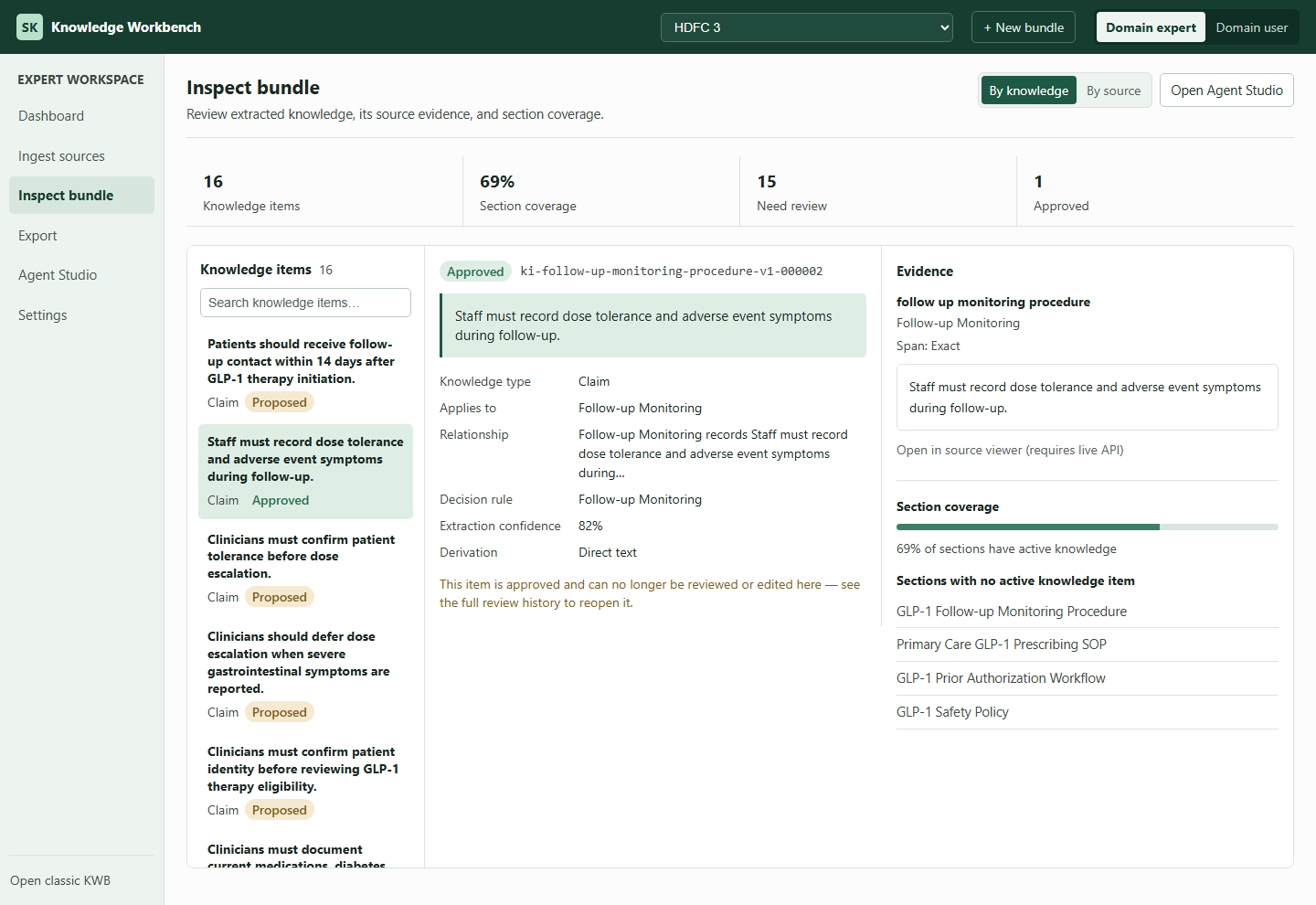
That ends with a local web app at http://127.0.0.1:8765: browse sources, review mined knowledge, chat with the in-browser agent. Here's the Inspect bundle screen, browsing by knowledge, on a GLP-1 healthcare SOP set — a proposed item with its evidence and review actions, next to an already-approved one:
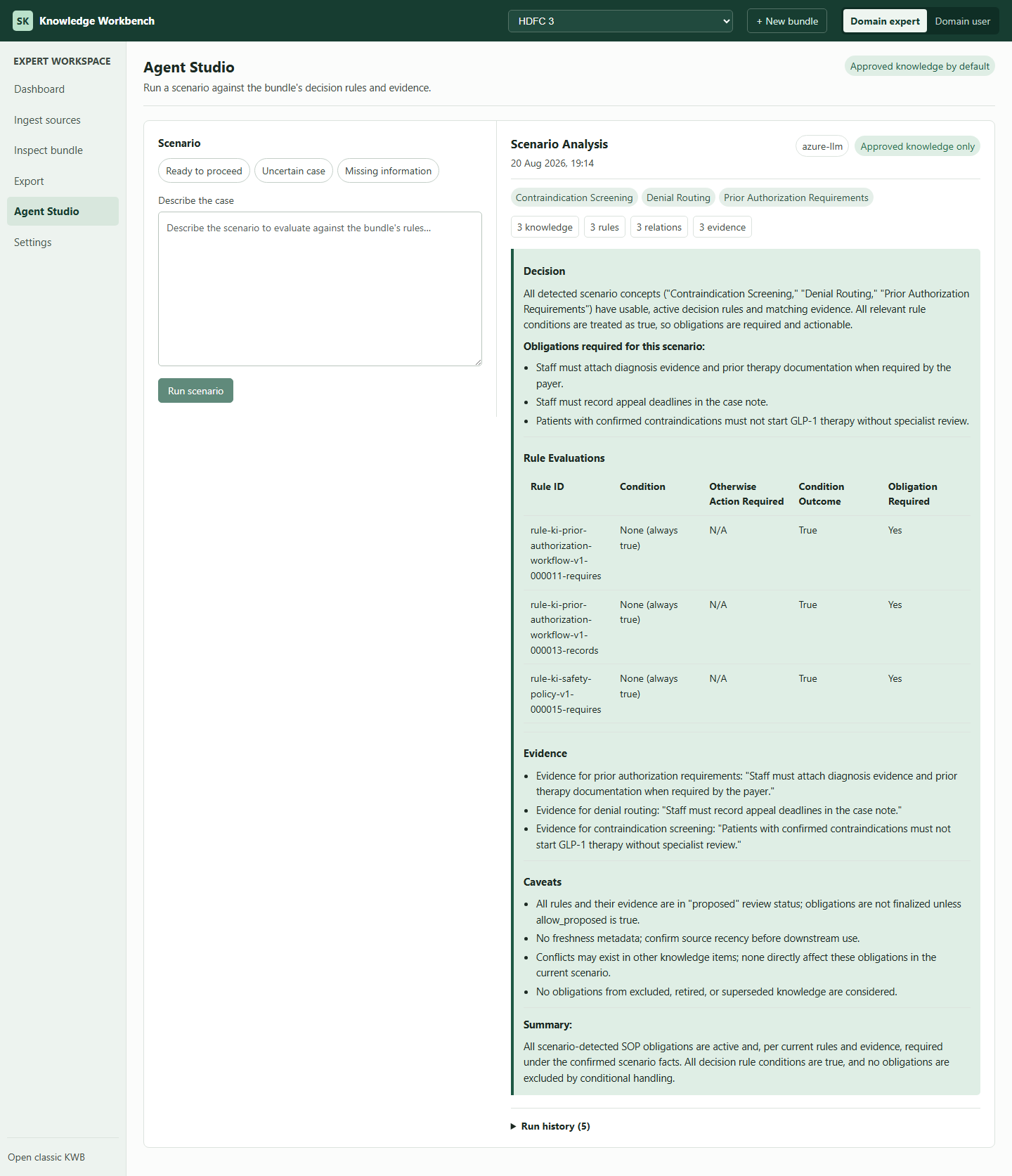
And here's the payoff — Agent Studio actually consuming that knowledge to answer a scenario, with its detected concepts, retrieved-context counts, rule evaluations, and evidence shown alongside the answer:
→ Run the full walkthrough on the Quickstart page — every command, expected output at each step, a CLI example of an agent retrieving grounded context, and a second tutorial using a richer DOCX/PDF reference bundle.
Reference bundle
A synthetic, fully worked GLP-1 healthcare example lives at examples/glp1-healthcare. It includes:
- Multiple SOP-like sources, with DOCX/PDF ingestion
- Evidence-backed proposed knowledge
- Persisted human-in-the-loop review states
- Conflict and freshness reports
- OKF, Graph JSON, and RDF exports
Where this fits
Free and complete on its own
KL4A handles extraction, evidence grounding, and human review. Free. Local-first. Yours to run anywhere, forever.
Deterministic enforcement, cross-bundle reasoning, audit trails, and governed multi-tenant operation in production are a separate, deliberately out-of-scope concern — a downstream layer this project doesn't try to be. KL4A is a tool for the layer where ontology projects actually fail — this is how your SOPs get ready for that layer, whether or not you ever adopt anything downstream of it. See WHY_OPEN_CORE.md for exactly where that line sits, why, and who maintains this project.
Guides
- Why This Exists — why KL4A exists and why it's open.
- Quickstart — step-by-step install and first bundle, with expected output.
- Desktop UI Guide — the desktop app, screen by screen.
- MCP Server — connecting an agent to a bundle you've built.
- Architecture — how the pieces fit together.
- FAQ — common setup and ingestion problems.
Everything above is sopkb. The other option has its own tab:
codekb for a source repository.
Project
- Contributing — dev setup, tests, PR process, DCO sign-off.
- Governance — project governance and the open-source/enterprise boundary.
- Roadmap — where the project is headed.
- License — Apache-2.0.
- GitHub repository
KL4A · Apache-2.0 · maintainers & boundary